
More languages
More actions
Product Images
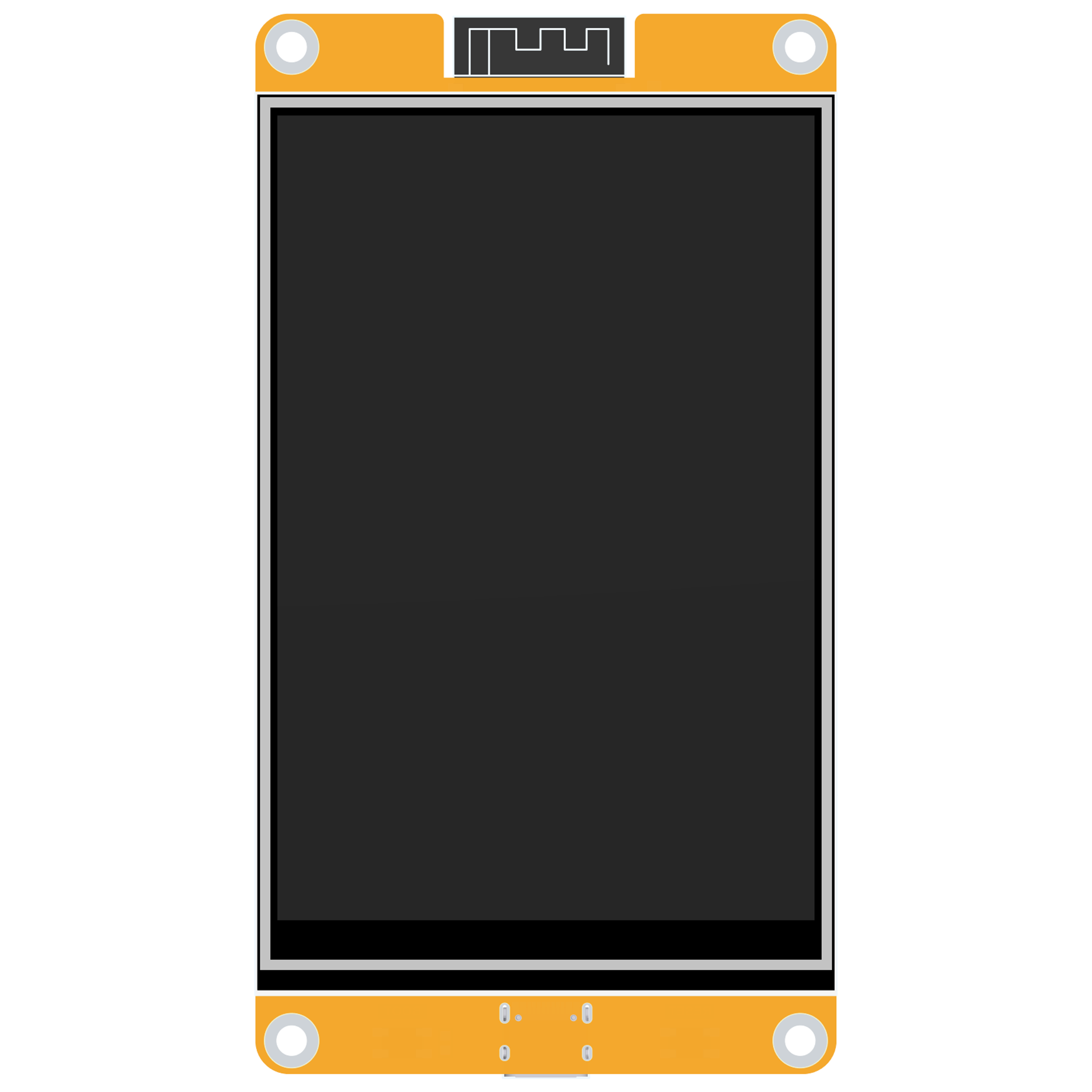
E32R40T-TopView
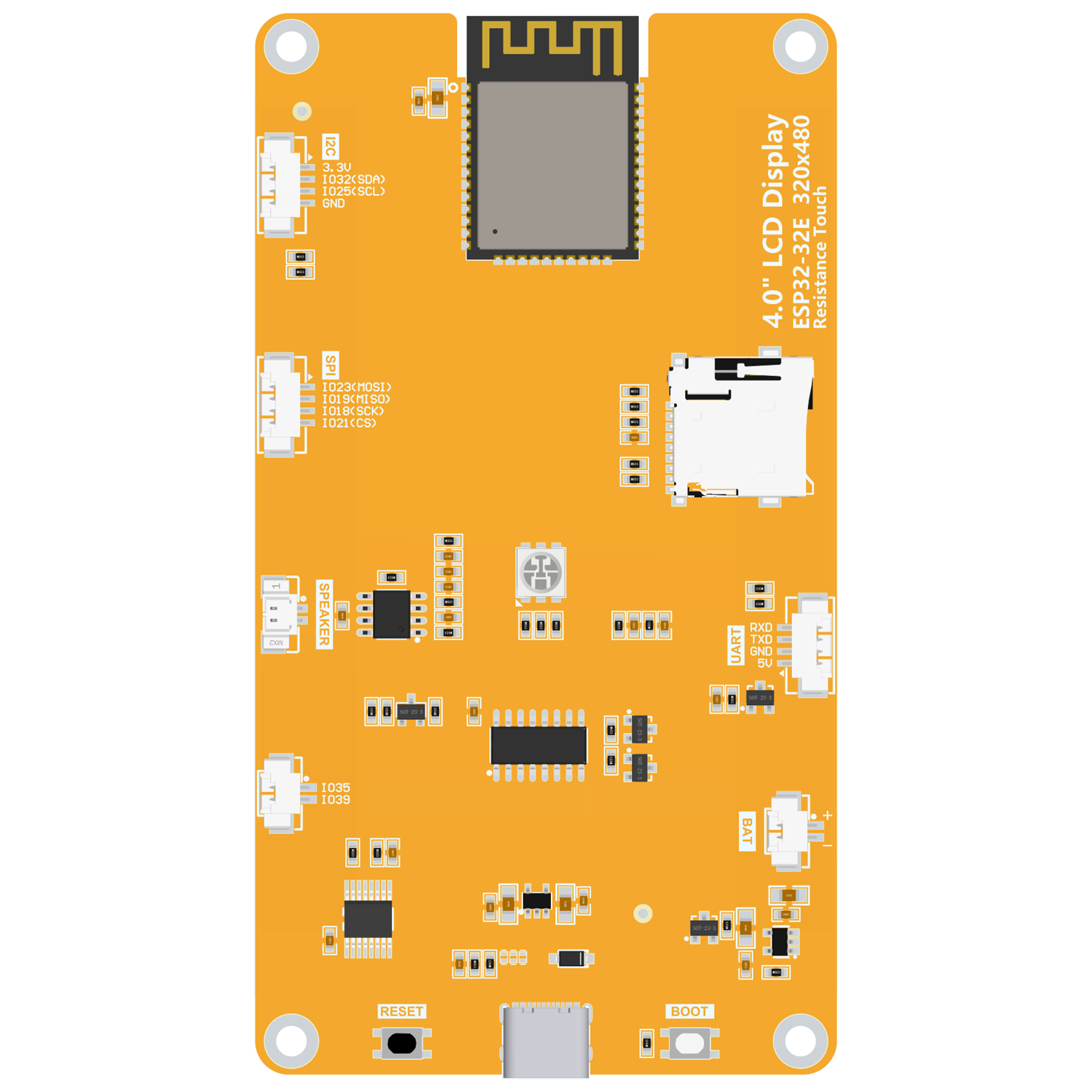
E32R40T-BottomView


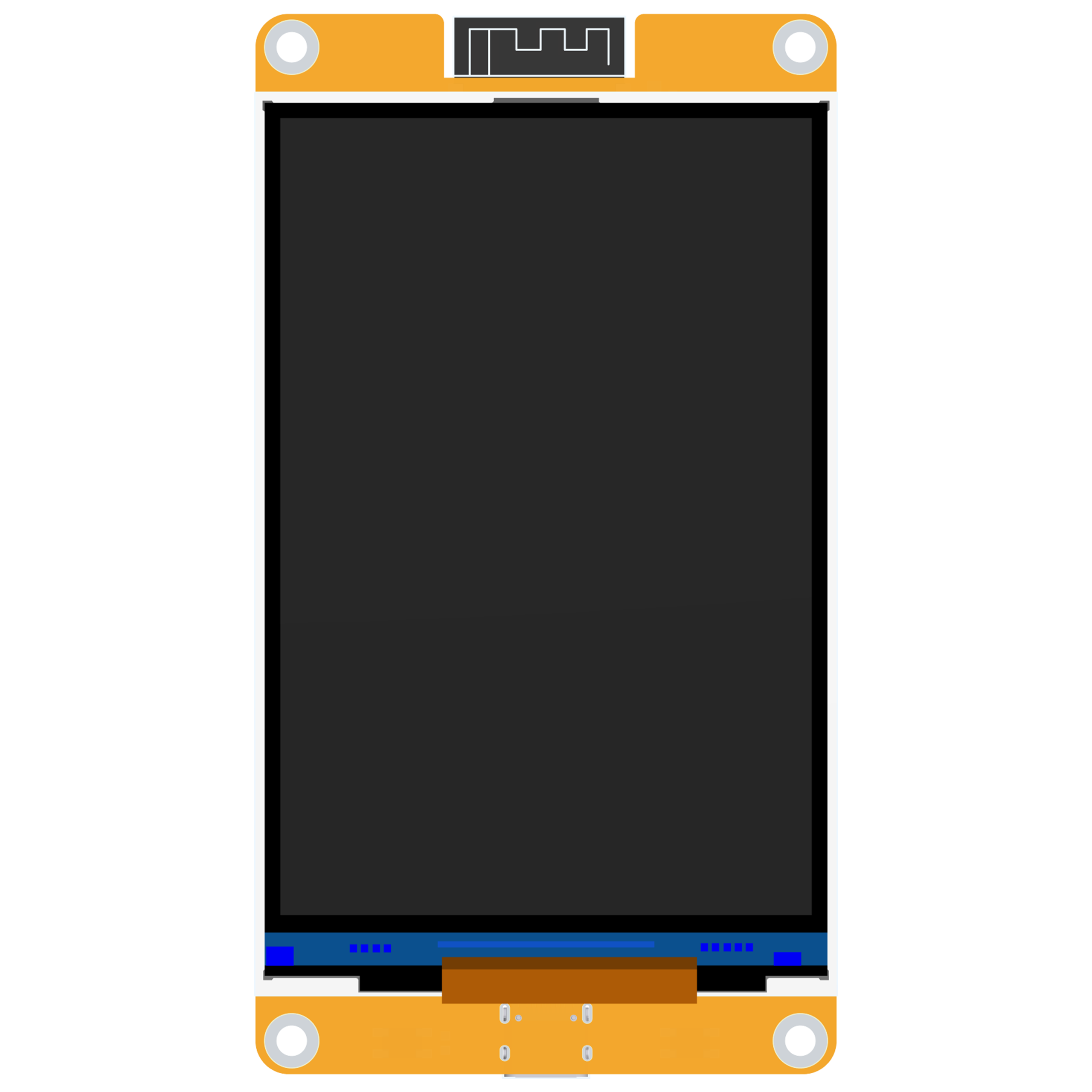
E32N35T-TopView
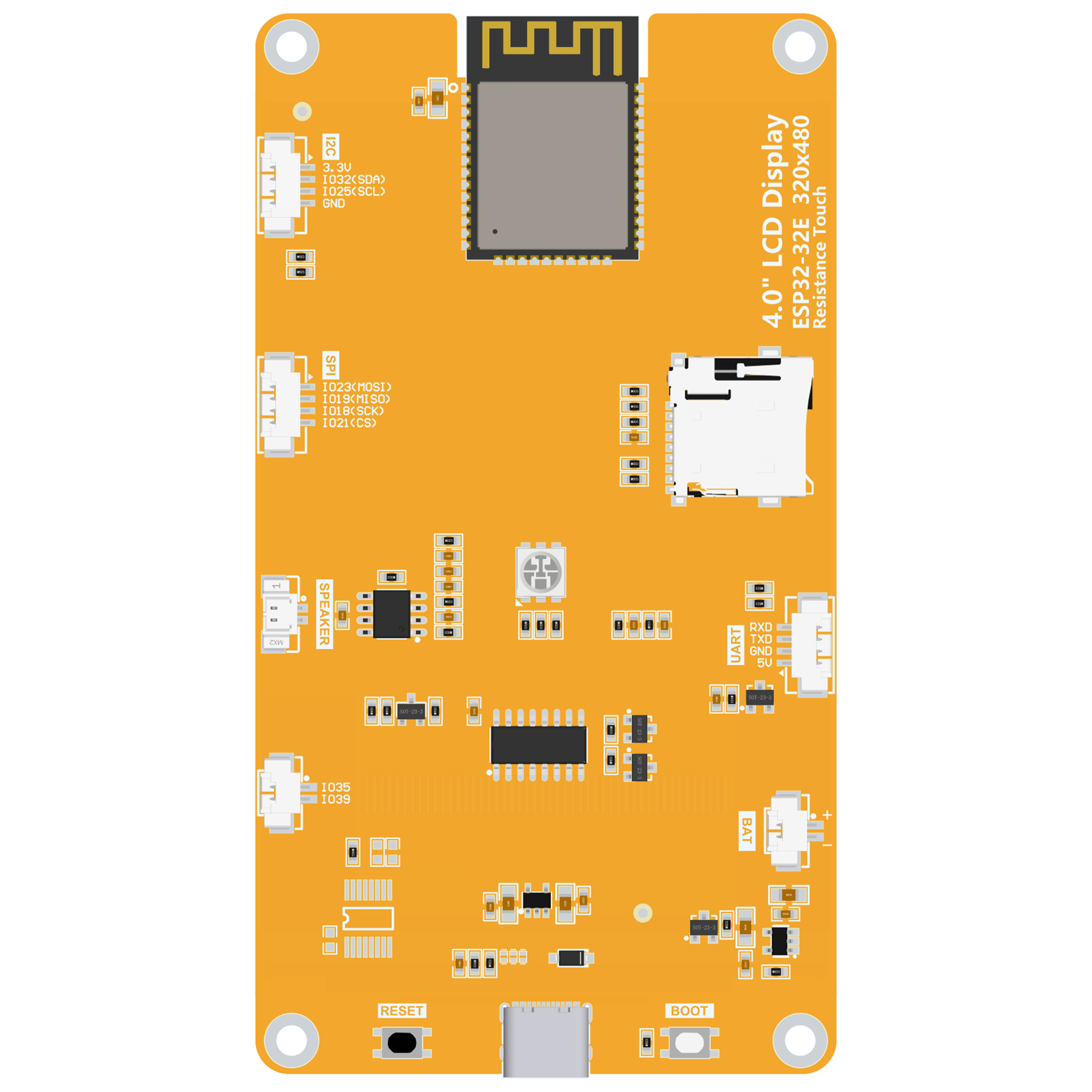
E32N40T--BottomView


Product Introduction
- It comes with an ESP32-32E module, which is convenient for development and has sufficient development resources.
- 3.95/4.0-inch color screen with a resolution of 320x480, supporting a maximum of 262K colors (RGB666), and displaying rich colors.
- Rich interfaces, making it convenient to connect various peripherals (such as I2C, SPI, UART and other peripherals).
- Supports external speakers for audio playback.
- Comes with an RGB tricolor indicator light, providing rich status indications.
- Comes with a resistive touch screen, facilitating human-computer interaction.
- Standard TYPE-C interface, making it convenient for program downloading and power supply.
- Comes with a micro TF card slot, making it convenient to expand storage.
- Supports external lithium batteries, which is lightweight and portable.
- Comes with a battery charging management circuit to ensure the safe charging and discharging of the battery.
- Provides rich example programs, making it convenient for learning.
- Provides underlying driver technical support, and WIKI materials are updated online.
- The module has undergone multiple aging tests and can reach military-grade standards, supporting long-term stable operation.
Product Parameters
ESP32 Main Control Parameters
| Name | Parameters |
|---|---|
| Module | ESP32-32E |
| CPU | ESP32-D0WD-V3, Xtensa dual-core 32-bit LX6 microprocessor |
| Main Frequency | 240MHz (maximum) |
| Storage | 448KB ROM + 520KB SRAM + 16KB RTC SRAM + 4MB external QSPI Flash |
| WIFI | 2.4GHz, 802.11b/g/n mode |
| Bluetooth | Bluetooth V4.2 BR/EDR and Bluetooth LE standards |
| Operating Voltage | 3.0~3.6(V) |
| Operating Temperature | –40~85(℃) |
Liquid Crystal Screen Parameters
| Name | Parameters |
|---|---|
| Screen Size | 3.95/4.0 inch |
| Screen Type | TN TFT |
| Resolution | 320xRGBx480(pixels) |
| Effective Display Area | 55.68(W)x83.52(H)(mm) |
| Number of Colors | Maximum: 262K(RGB666)
Commonly used: 65K(RGB565) |
| Driver IC | ST7796S |
| Display Interface | 4-Line SPI(connected to ESP32) |
| Pixel Size | 0.174(H)x0.174(mm) |
| Viewing Angle | 12 0’CLOCK |
| Backlight Brightness (Typical Value) | 450cd/m2 |
| Backlight Type | White LED*8 |
| Operating Temperature | -10~50(℃) |
| Storage Temperature | -20~60(℃) |
Touch Screen Parameters
| Name | Parameters |
|---|---|
| Effective Area Size | 3.95 inch |
| Touch Screen Type | Resistive touch screen |
| Driver IC | XPT2046 |
| Effective Touch Area | 56.28(W)x84.32(H)(mm) |
| Visible Window Size | 56.88(W)x85.22(H)(mm) |
| Communication Interface | SPI |
| Structural Material | ITO film + ITO glass |
| Operating Temperature | -10~60(℃) |
| Storage Temperature | -20~70(℃) |
Size Parameters
| Name | Parameters |
|---|---|
| Liquid Crystal Screen Outline Dimensions | 60.88±0.2(W)x94.57±0.2(H)x2.5±0.1(D)(mm)(excluding the cable and back adhesive) |
| Touch Screen Outline Dimensions | 60.48±0.2(W)x93.87±0.2(H)x1.05±0.1(D)(mm)(excluding the cable and back adhesive) |
| Module Outline Dimensions | With touch screen: 60.88(W)x111.11(H)x5.65(D)(mm)
Without touch screen: 60.88(W)x111.11(H)x4.60(D)(mm) |
Battery Charging Parameters
| Name | Parameters |
|---|---|
| Charging Voltage | Range: 4.2~6.5(V)
Typical value: 5V |
| Charging Current | Maximum value: 500mA
Module actual value: 290mA |
| Charging Saturation Voltage | 4.24V |
| Charging Temperature | Module actual maximum value: 62℃ |
| Charging Battery Specifications | 3.7V polymer lithium battery |
Electrical Parameters
| Name | Parameters |
|---|---|
| Operating Voltage | 5.0V |
| Backlight Current | 142mA |
| Total Current | When ESP32 is reset: 40mA
When only the display screen is working: 230mA When the display screen, speaker, and battery charging are all working: 580mA |
| Power Consumption | 1.15W (when only the display screen is working) |
| Backlight Brightness (Actual Value) | With touch screen: 370 cd/m2 Without touch screen: 472 cd/m2 |
| Supported Speaker Power Consumption (Maximum) | 1.5W(8Ω) or 2W(4Ω) |
Basic Parameters
| Name | Parameters |
|---|---|
| SKU |
With touch screen: E32R40T |
| Power Supply Interface | TYPE-C |
| Weight (Including Packaging) | E32R40T: 130 g
E32N40T: 119 g |
Interface Definition

Interface Function Description
| Interface | Function Description |
|---|---|
| ESP32-32E Module | The main control of the display module, controlling on-board peripherals and external peripherals. |
| MicroSD Card Slot | Insert a Micro SD card to expand the storage space, such as storing large data contents like font libraries, pictures, and audio files. |
| RGB Tricolor Light | Includes red, green, and blue LED lights, and each light can be controlled by an IO to indicate the status. |
| Serial Port | 1.25mm 4P socket. It can be used for serial port debugging, downloading, and communication. An external USB-to-serial port module is required. |
| Battery Interface | 1.25mm 2P socket, used to connect a 3.7V polymer lithium battery.
The battery is charged through the battery charging management circuit, and it can also be used for battery power supply. Pay attention to the positive and negative poles of the interface. |
| BOOT Button | Used to enter the download mode or perform button testing.
Press and hold this button while powering on, and then release it to enter the download mode. Or after powering on, press and hold this button, then press the RESET button, release the RESET button, and then release this button to enter the download mode. When there is no need to enter the download mode, this button can be used as a normal button. |
| TYPE-C Interface | Used for module power supply and program downloading. This interface is connected to the one-click download circuit on the module,
and it can automatically enter the download mode (no need to press the BOOT button). |
| RESET Button | Used for resetting the ESP32 main control and the LCD. Press it for level reset. |
| Expansion Input Pins | 1.25mm 2P socket. IO35 and IO39 are two IO pins with only input functions, used to connect input signals. |
| Speaker Interface | 1.25mm 2P socket. Used to connect a speaker for audio playback. |
| SPI Peripheral Interface | 1.25mm 4P socket. Used to connect external SPI communication devices. This SPI interface shares with the MicroSD. It can be used as a normal IO. |
| I2C Peripheral Interface | 1.25mm 4P socket. Used to connect external IIC communication devices. It can be used as a normal IO. |
ESP32 Pin Assignment
| On-board Device | ESP32 Connected Pin | On-board Device Pin Description |
|---|---|---|
| Liquid Crystal Screen | IO15 | Liquid crystal screen chip select control signal, low level is valid |
| IO2 | Liquid crystal screen command/data selection control signal
High level: data, low level: command | |
| IO14 | SPI bus clock signal (shared by the liquid crystal screen and the touch screen) | |
| IO13 | SPI bus write data signal (shared by the liquid crystal screen and the touch screen) | |
| IO12 | SPI bus read data signal (shared by the liquid crystal screen and the touch screen) | |
| EN | Liquid crystal screen reset control signal, low level resets (shares the reset pin with the ESP32-32E main control) | |
| IO27 | Liquid crystal screen backlight control signal (high level turns on the backlight, low level turns off the backlight) | |
| Resistive Touch Screen | IO14 | SPI bus clock signal (shared by the touch screen and the liquid crystal screen) |
| IO13 | SPI bus write data signal (shared by the touch screen and the liquid crystal screen) | |
| IO12 | SPI bus read data signal (shared by the touch screen and the liquid crystal screen) | |
| IO33 | Resistive touch screen chip select control signal, low level is valid | |
| IO36 | Resistive touch screen touch interrupt signal. When a touch occurs, a low level is input to the main control. | |
| RGB Tricolor Light | IO22 | Red LED light (common anode, low level turns it on, high level turns it off) |
| IO16 | Green LED light (common anode, low level turns it on, high level turns it off) | |
| IO17 | Blue LED light (common anode, low level turns it on, high level turns it off) | |
| MicroSD Card | IO5 | SD card chip select signal, low level is valid |
| IO23 | SD card SPI bus write data signal (shared by MicroSD card and SPI peripherals) | |
| IO18 | SD card SPI bus clock signal (shared by MicroSD card and SPI peripherals) | |
| IO19 | SD card SPI bus read data signal (shared by MicroSD card and SPI peripherals) | |
| Audio | IO4 | Audio enable signal, low level enables, high level disables |
| IO26 | Audio signal DAC output signal | |
| Button | IO0 | Download mode selection button (press and hold this button while powering on, and then release it to enter the download mode) |
| EN | ESP32-23E reset button, low level resets (shares the reset with the liquid crystal screen) | |
| Serial Port |