
More actions
No edit summary |
|||
| Line 1: | Line 1: | ||
== <big>How to install Soft Keyboard</big> == | == <big>How to install Soft Keyboard</big> == | ||
<big>This installation tutorial uses "2016-05-27-raspbian-jessie" version for testing. If use wheezy or earlier image, then the step5 and step6 have different file paths, please refer to the virtual-keyboard official installation tutorial for specification. | <big>This installation tutorial uses "2016-05-27-raspbian-jessie" version for testing. If use wheezy or earlier image, then the step5 and step6 have different file paths, please refer to the virtual-keyboard official installation tutorial for specification.</big> | ||
Official reference address (English) | |||
<big>Official reference address (English) | |||
http://ozzmaker.com/virtual-keyboard-for-the-raspberry-pi/</big> | http://ozzmaker.com/virtual-keyboard-for-the-raspberry-pi/</big> | ||
| Line 14: | Line 15: | ||
<big>(Note: "./ autogen.sh" execution takes a few minutes, and would show as follows after running correctly; if it doesn’t show as follows, then need to check to see if there are error Popup Window prompt) | <big>(Note: "./ autogen.sh" execution takes a few minutes, and would show as follows after running correctly; if it doesn’t show as follows, then need to check to see if there are error Popup Window prompt) | ||
[[File:Soft_Keyboard-01.png|750px]]</big> | [[File:Soft_Keyboard-01.png|750px]]</big> | ||
<big>Continue: | <big>Continue:</big> | ||
sudo make | |||
sudo make install</big> | <big>sudo make</big> | ||
<big>sudo make install</big> | |||
<big><br />3. Install the shared data library for matchbox-keyboard | <big><br />3. Install the shared data library for matchbox-keyboard | ||
| Line 24: | Line 27: | ||
<big>[[File:Soft_Keyboard-02.png|750px]]</big> | <big>[[File:Soft_Keyboard-02.png|750px]]</big> | ||
<big>4. Create a virtual keyboard startup script | <big>4. Create a virtual keyboard startup script</big> | ||
sudo nano /usr/bin/toggle-matchbox-keyboard.sh</big> | |||
<big>sudo nano /usr/bin/toggle-matchbox-keyboard.sh</big> | |||
<big>Paste the following, press Ctrl + X and Y, to save then exit</big> | <big>Paste the following, press Ctrl + X and Y, to save then exit</big> | ||
| Line 31: | Line 35: | ||
<big>!/bin/bash</big><big>This script toggle the virtual keyboard</big> | <big>!/bin/bash</big><big>This script toggle the virtual keyboard</big> | ||
<big>PID=`pidof matchbox-keyboard` | <big>PID=`pidof matchbox-keyboard`</big> | ||
if [ ! -e $PID ]; then | |||
killall matchbox-keyboard | <big>if [ ! -e $PID ]; then</big> | ||
else | |||
matchbox-keyboard -s 50 extended& | <big>killall matchbox-keyboard</big> | ||
<big>else</big> | |||
<big>matchbox-keyboard -s 50 extended&fi</big> | |||
<big>Add executable permission for the script above</big> | |||
<big>sudo chmod +x /usr/bin/toggle-matchbox-keyboard.sh</big> | |||
<big><br />5. Add script above to Start menu</big> | |||
<big>sudo nano /usr/share/applications/toggle-matchbox-keyboard.desktop</big> | |||
<big>Paste the following content, press Ctrl + X and Y, to save then exit</big> | |||
<big>[Desktop Entry]</big> | |||
<big>Name=Toggle Matchbox Keyboard</big> | |||
<big>Comment=Toggle Matchbox Keyboard</big> | |||
<big>Exec=toggle-matchbox-keyboard.sh</big> | |||
<big>Type=Application</big> | |||
<big> | <big>Icon=matchbox-keyboard.png</big> | ||
<big> | <big>Categories=Panel;Utility;MB</big> | ||
<big> | <big>X-MB-INPUT-MECHANSIM=True</big> | ||
X-MB-INPUT-MECHANSIM=True</big> | |||
<big>6. Create an icon on the taskbar (Note that in this step, must be "pi" user privileges, if you use administrator privileges, will not find the file) | <big>6. Create an icon on the taskbar (Note that in this step, must be "pi" user privileges, if you use administrator privileges, will not find the file) | ||
Revision as of 11:39, 19 May 2018
How to install Soft Keyboard
This installation tutorial uses "2016-05-27-raspbian-jessie" version for testing. If use wheezy or earlier image, then the step5 and step6 have different file paths, please refer to the virtual-keyboard official installation tutorial for specification.
Official reference address (English) http://ozzmaker.com/virtual-keyboard-for-the-raspberry-pi/
1. Install the necessary files
sudo apt-get update
sudo apt-get install libfakekey-dev libpng-dev libxft-dev autoconf libtool
2. Install the matchbox-keyboard
git clone https://github.com/mwilliams03/matchbox-keyboard.git
cd matchbox-keyboard
./autogen.sh
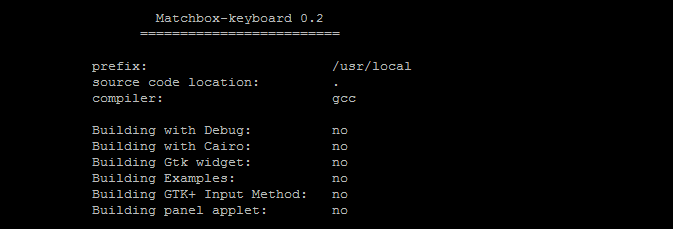
(Note: "./ autogen.sh" execution takes a few minutes, and would show as follows after running correctly; if it doesn’t show as follows, then need to check to see if there are error Popup Window prompt)

Continue:
sudo make
sudo make install
3. Install the shared data library for matchbox-keyboard
sudo apt-get install libmatchbox1
As following:

4. Create a virtual keyboard startup script
sudo nano /usr/bin/toggle-matchbox-keyboard.sh
Paste the following, press Ctrl + X and Y, to save then exit
!/bin/bashThis script toggle the virtual keyboard
PID=`pidof matchbox-keyboard`
if [ ! -e $PID ]; then
killall matchbox-keyboard
else
matchbox-keyboard -s 50 extended&fi
Add executable permission for the script above
sudo chmod +x /usr/bin/toggle-matchbox-keyboard.sh
5. Add script above to Start menu
sudo nano /usr/share/applications/toggle-matchbox-keyboard.desktop
Paste the following content, press Ctrl + X and Y, to save then exit
[Desktop Entry]
Name=Toggle Matchbox Keyboard
Comment=Toggle Matchbox Keyboard
Exec=toggle-matchbox-keyboard.sh
Type=Application
Icon=matchbox-keyboard.png
Categories=Panel;Utility;MB
X-MB-INPUT-MECHANSIM=True
6. Create an icon on the taskbar (Note that in this step, must be "pi" user privileges, if you use administrator privileges, will not find the file) nano ~/.config/lxpanel/LXDE-pi/panels/panel
7. Find the resembles similar to the following command (default content may be different in different Raspberry Pi versions) Plugin { type=launchbar Config {
   Button {
     id=/usr/share/applications/lxde-x-www-browser.desktop
   }
   Button {
     id=/usr/share/raspi-ui-overrides/applications/pcmanfm.desktop
   }
   Button {
     id=/usr/share/raspi-ui-overrides/applications/lxterminal.desktop
   }
   Button {
     id=/usr/share/applications/wolfram-mathematica.desktop
   }
   Button {
     id=/usr/share/applications/wolfram-language.desktop
   }
 }
}
Add the following code to add an icon item
Button {
id=toggle-matchbox-keyboard.desktop
}
After modifying, would show as below:

8. After modifying, run the following command and re-start the system; you will see a virtual keyboard icon in taskbar on the screen normally. sudo reboot
P.S. Log into via SSH to see how to change the size of the virtual keyboard
DISPLAY=:0.0 matchbox-keyboard -s 50 extended DISPLAY=:0.0 matchbox-keyboard -s 100 extended