
More actions
Created page with "123" |
No edit summary |
||
| (17 intermediate revisions by 3 users not shown) | |||
| Line 1: | Line 1: | ||
{{lan | |||
| | |||
cn=https://www.lcdwiki.com/zh/1.8inch_Arduino_SPI_Module_ST7735S_SKU:MAR1801 | |||
| | |||
en=https://www.lcdwiki.com/1.8inch_Arduino_SPI_Module_ST7735S_SKU:MAR1801 | |||
}} | |||
== <font color="blue">Product Picture</font> == | |||
[[File:MAR1801-001.jpg|300px]] | |||
[[File:MAR1801-003.jpg|300px]] | |||
==<font color="blue">Product Description</font> == | |||
* 1.8-inch color screen,support 65K color display,display rich colors | |||
* 128X160 resolution, clear display | |||
* Using the SPI serial bus, it only takes a few IOs to illuminate the display | |||
* With SD card slot for convenient function expansion | |||
* Provide underlying libraries and rich sample programs for Arduino, C51, and STM32 platforms | |||
* Military-grade process standards, long-term stable work | |||
* Provide underlying driver technical support | |||
==<font color="blue">Product Parameters</font> == | |||
{| class="wikitable" border="1" style="width: 500px; background-color: white;" | |||
| align="center" |Name | |||
| align="center" |Parameter | |||
|- | |||
| align="center" |Display Color | |||
| align="center" |16BIT RGB 65K color | |||
|- | |||
| align="center" |SKU | |||
| align="center" |MAR1801 | |||
|- | |||
| align="center" |Screen Size | |||
| align="center" |1.8(inch) | |||
|- | |||
| align="center" |Type | |||
| align="center" |TFT | |||
|- | |||
| align="center" |Driver IC | |||
| align="center" |ST7735S | |||
|- | |||
| align="center" |Resolution | |||
| align="center" |128*160 (Pixel) | |||
|- | |||
| align="center" |Luminance | |||
| align="center" |320Cd/m<sup>2</sup> | |||
|- | |||
| align="center" |Module Interface | |||
| align="center" |4-wire SPI interface | |||
|- | |||
| align="center" |Backlight | |||
| align="center" |2 White Led | |||
|- | |||
| align="center" |Active Area | |||
| align="center" |28.03x35.04 (mm) | |||
|- | |||
| align="center" |Module PCB Size | |||
| align="center" |38.30x62.48 (mm) | |||
|- | |||
| align="center" |Operating Temperature | |||
| align="center" | -30℃~80℃ | |||
|- | |||
| align="center" |Storage Temperature | |||
| align="center" | -30℃~80℃ | |||
|- | |||
| align="center" |Operating Voltage | |||
| align="center" |3.3V | |||
|- | |||
| align="center" |LED Current | |||
| align="center" |40.8(mA) | |||
|- | |||
| align="center" |Power Consumption | |||
| align="center" |0.21w | |||
|- | |||
| align="center" |Rough Weight(Package containing) | |||
| align="center" |18 (g) | |||
|} | |||
==<font color="blue">Interface Definition</font> == | |||
[[file:MAR1801-004.png|550x550px]] | |||
{| class="wikitable" border="1" style="width: 550px; background-color: white;" | |||
| align="center" |Number | |||
| align="center" |Pin Label | |||
| align="center" |Description | |||
|- | |||
| align="center" |1 | |||
| align="center" |VCC | |||
|LCD Power positive (3.3V~5V) | |||
|- | |||
| align="center" |2 | |||
| align="center" |GND | |||
|LCD Power ground | |||
|- | |||
| align="center" |3 | |||
| align="center" |GND | |||
|LCD Power ground | |||
|- | |||
| align="center" |4 | |||
| align="center" |NC | |||
|Not defined, reserved | |||
|- | |||
| align="center" |5 | |||
| align="center" |NC | |||
|Not defined, reserved | |||
|- | |||
| align="center" |6 | |||
| align="center" |NC | |||
|Not defined, reserved | |||
|- | |||
| align="center" |7 | |||
| align="center" |CLK | |||
|LCD SPI bus clock signal | |||
|- | |||
| align="center" |8 | |||
| align="center" |SDA | |||
|LCD SPI bus write data signal | |||
|- | |||
| align="center" |9 | |||
| align="center" |RS | |||
|LCD register / data selection signal, | |||
high level: register, low level: data | |||
|- | |||
| align="center" |10 | |||
| align="center" |RST | |||
|LCD reset signal, low level reset | |||
|- | |||
| align="center" |11 | |||
| align="center" |CS | |||
|LCD chip select signal, low level enable | |||
|- | |||
|} | |||
==<font color="blue">Connect to Arduino</font> == | |||
{| class="FCK__ShowTableBorders" align="left" | |||
|- | |||
![[file:MAR1801-007.jpg|无框|400x400px]] | |||
![[file:MAR1801-008.jpg|无框|400x400px]] | |||
|- | |||
| align="center" | '''Arduino UNO direct insertion picture''' | |||
| align="center" | '''Arduino Mega2560 direct insertion picture''' | |||
|} | |||
<br clear="all"> | |||
==<font color="blue">How to use on Arduino</font> == | |||
*'''Step 1: Download the test program''' | |||
# Download the Arduino test program from the [[#Program Download|'''Program Download''']] column | |||
# For a description of the relevant test procedures, please refer to the test program documentation in the package | |||
*'''Step 2: Connect the Arduino development board''' | |||
# Plug the module directly into the Arduino development board ([[#Connect to Arduino| <font color="red"> '''Do not plug in?'''</font>]]) | |||
# After the module is plugged in, power on the Arduino board | |||
*'''Step 3: Copy the dependent library''' | |||
# Make sure the Arduino IDE is installed on your computer (if it is not installed: [https://www.arduino.cc/en/Main/Software '''Arduino IDE download URL''']) | |||
# After installing the Arduino IDE, you need to copy the dependent library to the Arduino project directory as follows: | |||
::(1) Decompress the downloaded test package | |||
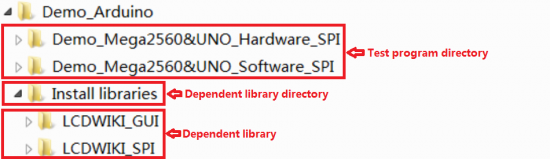
::(2) Copy the dependent libraries in the <font color="red"> '''Install libraries'''</font> directory in the package (shown below) to the <font color="red">'''libraries'''</font> folder | |||
:::of the Arduino project directory ([https://www.lcdwiki.com/res/PublicFile/Arduino_IDE_Use_Illustration_EN.pdf <font color="red"> '''Don't know the Arduino project directory?'''</font>]) | |||
::[[File:MAR1441-020.png|550px]] | |||
*'''Step 4: Compile and download the program to the development board''' | |||
# Open the sample in the Example directory of the package to test, compile and download([https://www.lcdwiki.com/res/PublicFile/Arduino_IDE_Use_Illustration_EN.pdf <font color="red"> '''Don't know how to compile and download?'''</font>]) | |||
*'''Step 5: Observe the running of the program''' | |||
# After the program is downloaded, run it directly and observe the running status. If it can be displayed normally, the program runs | |||
::successfully, as shown in the following figure (take the colligate_test test program as an example): | |||
::[[File:MAR1801-009.jpg|150px]] [[File:MAR1801-010.jpg|150px]] | |||
==<font color="blue">Program Download</font> == | |||
* [https://www.lcdwiki.com/res/Program/Arduino_SPI/1.8inch/Arduino_SPI_ST7735S_MAR1801_V1.0/1.8inch_Arduino_SPI_Module_ST7735S_MAR1801_V1.0.zip '''1.8 inch Arduino SPI Module Package'''] | |||
==<font color="blue">Product Documentation</font> == | |||
* [https://www.lcdwiki.com/res/MAR1801/1.8inch_Arduino_SPI_Module_MAR1801_User_Manual_EN.pdf '''1.8 inch Arduino SPI Module User Manual'''] | |||
* [https://www.lcdwiki.com/images/d/dc/1.8_SPI_MAR1801_Size.PNG '''1.8 inch Arduino SPI Module Size Picture'''] | |||
* [https://www.lcdwiki.com/res/MAR1801/QDTFT1801_specification_v1.1.pdf '''1.8 inch TFT Specifications'''] | |||
* [https://www.lcdwiki.com/res/MAR1801/1.8inch_SPI_MAR1801_Schematic.pdf '''1.8 inch Arduino SPI Module Schematic'''] | |||
* [https://www.lcdwiki.com/res/MAR1801/Altium_1.8_14pin_QDTFT1801_Package_library.zip '''1.8 inch QDTFT1801 TFT LCD Schematic and PCB Package Library'''] | |||
* [https://www.lcdwiki.com/res/MAR1801/ST7735S_V1.1_20111121.pdf '''Driver IC ST7735S Data sheet'''] | |||
==<font color="blue">Reference Materials</font> == | |||
* [https://www.lcdwiki.com/res/PublicFile/Arduino_IDE_Use_Illustration_EN.pdf '''Arduino IDE software use illustration'''] | |||
* [https://www.lcdwiki.com/res/PublicFile/C51_Keil%26stc-isp_Use_Illustration_EN.pdf '''C51 Keil and stc-isp software use illustration'''] | |||
* [https://www.lcdwiki.com/res/PublicFile/STM32_Keil_Use_Illustration_EN.pdf '''STM32 keil software use illustration'''] | |||
* [https://www.lcdwiki.com/res/PublicFile/PCtoLCD2002_Use_Illustration_EN.pdf '''PCtoLCD2002 software use illustration'''] | |||
* [https://www.lcdwiki.com/res/PublicFile/Image2Lcd_Use_Illustration_EN.pdf '''Image2Lcd software use illustration'''] | |||
* [https://www.lcdwiki.com/Chinese_and_English_display_modulo_settings '''Chinese and English display modulo settings'''] | |||
==<font color="blue">Common Software</font> == | |||
* [https://www.lcdwiki.com/res/software/PCtoLCD2002.zip '''PCtoLCD2002'''] | |||
* [https://www.lcdwiki.com/res/software/Image2Lcd.zip '''Image2Lcd'''] | |||
[[#top|BACK TO TOP]] | |||
Latest revision as of 14:21, 29 August 2025
Product Picture


Product Description
- 1.8-inch color screen,support 65K color display,display rich colors
- 128X160 resolution, clear display
- Using the SPI serial bus, it only takes a few IOs to illuminate the display
- With SD card slot for convenient function expansion
- Provide underlying libraries and rich sample programs for Arduino, C51, and STM32 platforms
- Military-grade process standards, long-term stable work
- Provide underlying driver technical support
Product Parameters
| Name | Parameter |
| Display Color | 16BIT RGB 65K color |
| SKU | MAR1801 |
| Screen Size | 1.8(inch) |
| Type | TFT |
| Driver IC | ST7735S |
| Resolution | 128*160 (Pixel) |
| Luminance | 320Cd/m2 |
| Module Interface | 4-wire SPI interface |
| Backlight | 2 White Led |
| Active Area | 28.03x35.04 (mm) |
| Module PCB Size | 38.30x62.48 (mm) |
| Operating Temperature | -30℃~80℃ |
| Storage Temperature | -30℃~80℃ |
| Operating Voltage | 3.3V |
| LED Current | 40.8(mA) |
| Power Consumption | 0.21w |
| Rough Weight(Package containing) | 18 (g) |
Interface Definition

| Number | Pin Label | Description |
| 1 | VCC | LCD Power positive (3.3V~5V) |
| 2 | GND | LCD Power ground |
| 3 | GND | LCD Power ground |
| 4 | NC | Not defined, reserved |
| 5 | NC | Not defined, reserved |
| 6 | NC | Not defined, reserved |
| 7 | CLK | LCD SPI bus clock signal |
| 8 | SDA | LCD SPI bus write data signal |
| 9 | RS | LCD register / data selection signal,
high level: register, low level: data |
| 10 | RST | LCD reset signal, low level reset |
| 11 | CS | LCD chip select signal, low level enable |
Connect to Arduino

|

|
|---|---|
| Arduino UNO direct insertion picture | Arduino Mega2560 direct insertion picture |
How to use on Arduino
- Step 1: Download the test program
- Download the Arduino test program from the Program Download column
- For a description of the relevant test procedures, please refer to the test program documentation in the package
- Step 2: Connect the Arduino development board
- Plug the module directly into the Arduino development board ( Do not plug in?)
- After the module is plugged in, power on the Arduino board
- Step 3: Copy the dependent library
- Make sure the Arduino IDE is installed on your computer (if it is not installed: Arduino IDE download URL)
- After installing the Arduino IDE, you need to copy the dependent library to the Arduino project directory as follows:
- (1) Decompress the downloaded test package
- (2) Copy the dependent libraries in the Install libraries directory in the package (shown below) to the libraries folder
- of the Arduino project directory ( Don't know the Arduino project directory?)

- Step 4: Compile and download the program to the development board
- Open the sample in the Example directory of the package to test, compile and download( Don't know how to compile and download?)
- Step 5: Observe the running of the program
- After the program is downloaded, run it directly and observe the running status. If it can be displayed normally, the program runs
- successfully, as shown in the following figure (take the colligate_test test program as an example):


Program Download
Product Documentation
- 1.8 inch Arduino SPI Module User Manual
- 1.8 inch Arduino SPI Module Size Picture
- 1.8 inch TFT Specifications
- 1.8 inch Arduino SPI Module Schematic
- 1.8 inch QDTFT1801 TFT LCD Schematic and PCB Package Library
- Driver IC ST7735S Data sheet

Reference Materials
- Arduino IDE software use illustration
- C51 Keil and stc-isp software use illustration
- STM32 keil software use illustration
- PCtoLCD2002 software use illustration
- Image2Lcd software use illustration
- Chinese and English display modulo settings